
Learning Disability and Autism Support in Northamptonshire
Giant Healthcare Corby provides learning disability support across Northamptonshire for children and young adults, at home, out in the community and in supported accommodation. We start with the person rather than the diagnosis, and we work with the routines and the communication they already have rather than replacing them.
- CQC registered
- Support workers matched on personality, not just skills
- We use the communication the person already uses
- Children and adults
- Referrals answered the same working day
Starting with the person
Two people with the same diagnosis can need completely different support. One may need help with everything except the thing everyone assumes they cannot do. Another may manage a whole day alone and come apart at a change of plan.
So we start by finding out what the person can already do, what they want, what makes a day go well and what makes it fall apart. That takes time and observation, not a form.
Plans are written with the person, in a format they can use, and revisited when they stop being true.
Communication
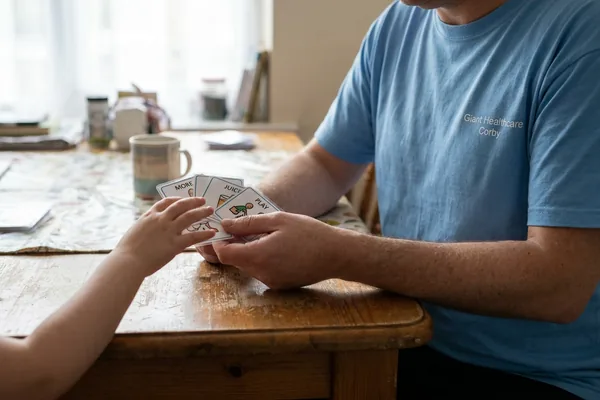
We work with whatever the person already uses. Speech, Makaton, symbols, photographs, a communication book, a tablet app, gesture, or a system only their family understands and nobody has written down.
Where somebody communicates through behaviour rather than words, we treat that as communication and work out what it is telling us.
We do not arrive with a new system and expect the person to learn it. If a new approach would genuinely help, we introduce it slowly and alongside the speech and language therapist, not instead of them.
Autism and predictability
For many autistic people the support that matters most is not extra help, it is fewer surprises.
That means the same support workers, the same order of events, honest warning when something is going to change, and someone who understands that a small change to a route or a plan is not a small thing.
We pay attention to sensory environment too. Noise, lights, textures and crowding cause more difficult days than most support plans admit.
Behaviour that challenges
Behaviour is communication. Something is wrong, and the behaviour is the message.
We look for the cause rather than logging the incident and moving on. Usually the answer is a change nobody explained, a sensory environment nobody adjusted, pain nobody noticed, or a need the person could not tell us about another way.
Restrictive practice is a last resort, recorded, reviewed and actively reduced. Our aim is fewer restrictions over time, not better managed ones.
Everyday skills
Cooking, shopping, money, travel, laundry, appointments, using a phone, staying safe online.
We do things with people rather than for them, which is slower and produces a better outcome. Where a skill can be learned, we support until it is, then step back. Where it cannot, we build support around it without making a point of it.

A life outside the support plan
College, work, volunteering, clubs, sport, friendships, faith, family. The things that are not services.
Support that only covers personal care and paperwork produces a very small life. We plan for the rest of it too, and we help people get to it rather than talking about it at reviews.
Where support happens
The approach on this page runs through all of them. The setting changes, the person does not.
- At home with family
- Through outreach and home support.
- In supported accommodation
- For adults aged 18 and over living in their own tenancy.
- In residential care
- For children and young people who cannot live at home.
- Through transitions
- When someone is moving from children's services into adult support.
Working with everyone else
Families, schools, colleges, social workers, speech and language therapists, occupational therapists, community learning disability teams and health services.
We follow plans written by clinicians rather than writing them, and we tell you what we are seeing between appointments, because support workers notice things nobody else is present for.
We provide personal care and daily living support. We do not provide nursing or clinical care.
Speak to the Corby office
You get the people who run the service, not a call centre. Ask for a registered manager.
Giant Healthcare Corby, Office 18, Corby Business Centre, Eismann Way, Corby, NN17 5ZB. Registered with the Care Quality Commission for personal care only, not nursing or clinical treatment. Location ID 1-5832866722. View our CQC profile.
Straight answers
Frequently asked questions
Yes. Children through outreach and residential care, and adults aged 18 and over in supported accommodation.
We use whatever they already use, whether that is Makaton, symbols, a communication app or gesture, and we work alongside their speech and language therapist.
Yes, wherever possible. Consistency matters more than almost anything else in this work.
Yes.
We plan the transition well in advance and keep familiar staff involved where we can.
Only as a last resort. It is recorded, reviewed and reduced, and the aim is always fewer restrictions.
Yes, for outreach and home support. Ask us and we will explain the options.
Talk to us
Tell us about the person rather than the diagnosis, and we will tell you what we would suggest, including when it is not us. Anything urgent, ring 07904 385455
A straight answerWe tell you honestly whether we can help, and point you in the right direction when we cannot.
Same working day responseAnd you do not need to know how support would be funded before you ask.
Prefer email? Send the same detail to hello@gianthealthcarecorby.co.uk