
Moving from Children's Services into Adult Support
Giant Healthcare Corby supports young people through the transition to adult services across Northamptonshire. Turning eighteen should not mean starting again with strangers. We plan the move early, build the skills first, and keep familiar people involved wherever we can, so that a birthday changes a legal status rather than a whole life.
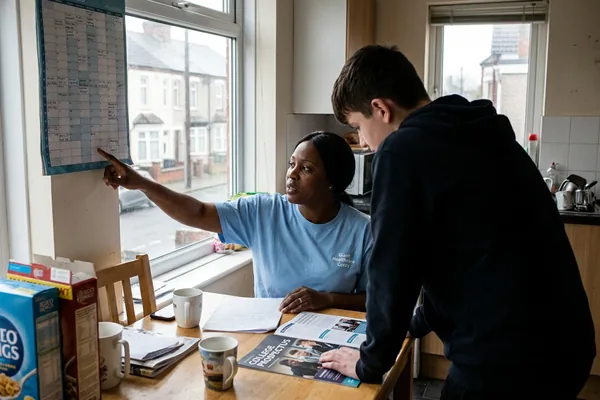
- Planning from 16
- Accommodation from 18
- Familiar staff kept involved where possible
- We work with transitions teams and personal advisers
- Referrals answered the same working day
Why transitions go wrong
Because they start too late, and because everything changes at once.
A young person turns eighteen and loses the social worker who knew them, the school that held their week together, the support hours that were funded under a different system, and often the adults they trusted. All of it in the same month, at the same time as being told to become independent.
It does not have to happen that way. Almost every difficult transition we see could have been a manageable one if the planning had begun two years earlier.
When planning should start
From 16. That is when preparing for adulthood work should be underway, not when the paperwork begins.
For young people with an education, health and care plan, support can continue to 25 where it is still needed. For care leavers, entitlements including a personal adviser continue past 18 as well. The eighteenth birthday is a change of framework, not a cliff edge, but only if somebody has planned for it.
If you are reading this and the young person is 17, it is not too late. It is just tighter.
How the ages work
- 16Planning starts
- 18Accommodation available
- 25EHCP support can run to
Planning can start from 16. Accommodation itself begins at 18, because supported accommodation for under 18s is a separate activity registered with Ofsted.
What we do during a transition
- We start with what they want
- Where they want to live, what they want to do in the day, who they want to keep seeing. Ambitions first, then the plan around them.
- We build the skills before the move
- Cooking, budgeting, travel, appointments, laundry, managing a phone and dealing with post. Practised while there is still a safety net, not discovered afterwards.
- We keep familiar people where we can
- If a support worker already knows the young person and the setting allows it, we try to keep them involved through the move.
- We plan the move itself
- Visits first, then overnight stays where appropriate, then the move, at a pace the young person sets rather than one the calendar sets.
- We stay afterwards
- The hardest fortnight is the one after everyone else has closed the file.
Moving into supported accommodation
For young people moving into their own place, our supported accommodation is for adults aged 18 and over. Planning and preparation can start well before that, and the move itself happens once the young person turns 18.
The aim is that the first night in a new flat is not the first time they have cooked a meal, paid a bill or been alone in the evening.

For care leavers
Leaving care is not the same as leaving home. There is often no bedroom to come back to, no one to ring about a broken boiler, and no fallback if something goes wrong in the first month.
We support care leavers aged 18 and over with practical independence, tenancies, money, work and study, and with the ordinary problems that everybody else takes to a parent.
We work alongside personal advisers and leaving care teams rather than duplicating what they do.
For young people with learning disabilities and complex needs
Transitions are hardest where the support is most detailed, because more can be lost in translation.
We carry the detail across. Communication methods, routines, sensory needs, what a good day looks like, what the early signs of a bad one are. Written down properly, handed over properly, and checked afterwards.
Where health involvement continues, we work alongside the adult teams taking over from the children ones.
Who we work with
Transitions teams, children's and adult social workers, personal advisers, leaving care teams, preparing for adulthood and SEND teams, schools and colleges, health services and families.
Transitions fail in the gaps between organisations. We would rather be the provider that chases the meeting than the one that waits for it.
Speak to the Corby office
You get the people who run the service, not a call centre. Ask for a registered manager.
Giant Healthcare Corby, Office 18, Corby Business Centre, Eismann Way, Corby, NN17 5ZB. Registered with the Care Quality Commission for personal care only, not nursing or clinical treatment. Location ID 1-5832866722. View our CQC profile.
Straight answers
Frequently asked questions
From 16. Earlier is better, and 17 is still workable.
No. Our accommodation is for adults aged 18 and over. We can support a 17 year old through outreach and planning, and provide accommodation once they turn 18.
We try, and often can, depending on the setting and the funding.
It can continue up to 25 where the young person still needs it. The adult teams involved change, and planning early makes that smoother.
Yes, from 18, alongside personal advisers and leaving care teams.
No, but it is tighter. Ring us and we will be honest about what is realistic.
Usually the local authority. We can explain the routes and who to ask if you are not sure.
Ask about transitions
Tell us the young person age and when the change is coming, and we will tell you what we would start with. If the timescale is short, ring rather than email on 07904 385455
A straight answerWe tell you honestly whether we can help, and point you in the right direction when we cannot.
Same working day responseAnd you do not need to know how support would be funded before you ask.
Prefer email? Send the same detail to hello@gianthealthcarecorby.co.uk